
The Nabagunjra Series · Blog 01 of 09
A Nabagunjra walked into my life long before I knew its name.
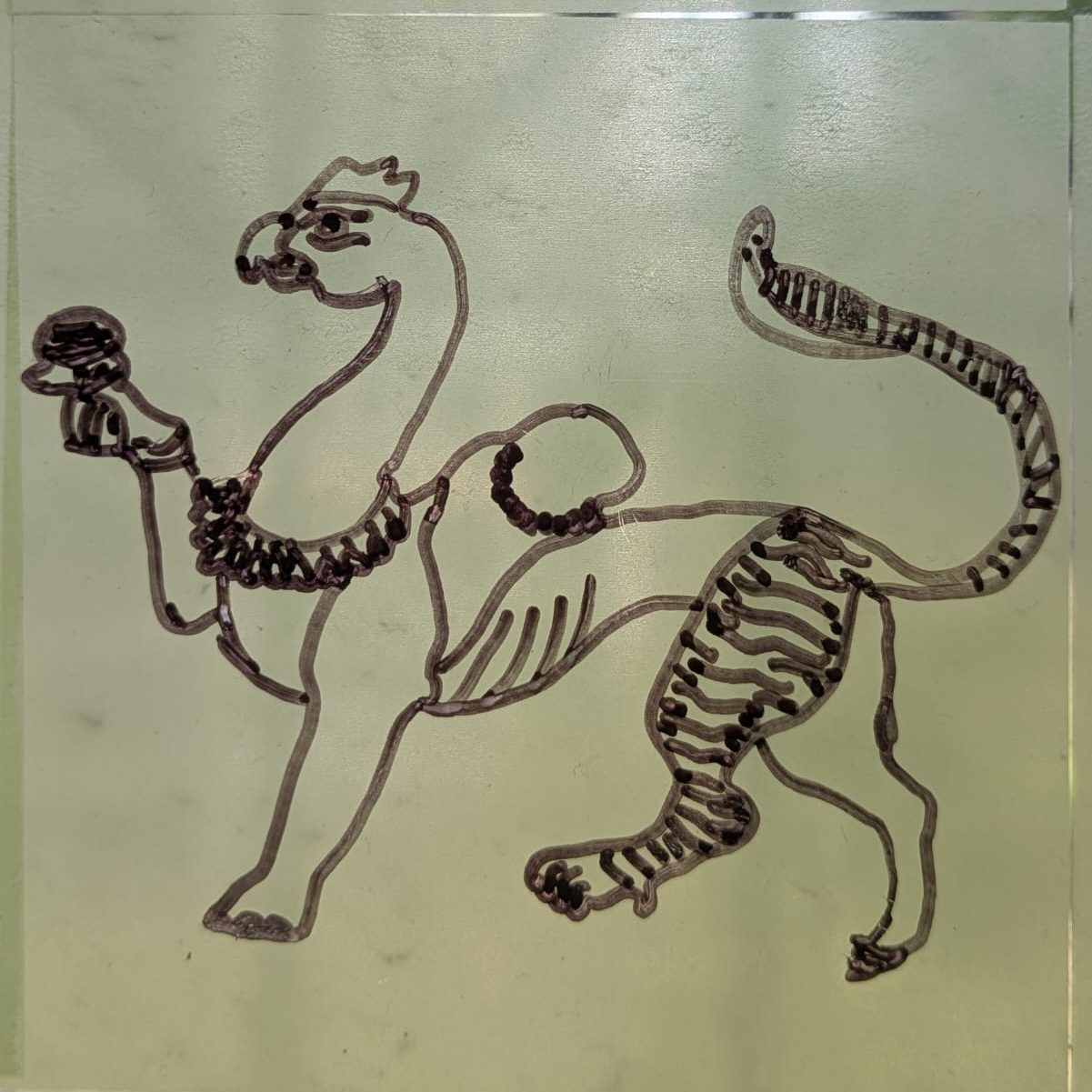
Image Courtesy: Shrijay Tripathy
I don’t remember the first time I saw Nabagunjra.
That’s the strange part.
In the background of childhood, while visiting Puri, through the lines of Pattachitra, eyes used to wander from floral borders to depictions, and in some corners of these stories, certain passing elements were never elaborated on for me, at that time.
I had seen it a hundred times before I could tell you what it was. If you are Odia, you know this feeling. It was like a story, neither told nor heard, but was overheard through conversations.
Nabagunjra appears everywhere, on fabric, on paintings, on the walls of cultural institutions, on the covers of magazines during Rath Yatra, and on the backs of pamphlets distributed at festivals. It is not hidden. It is everywhere.
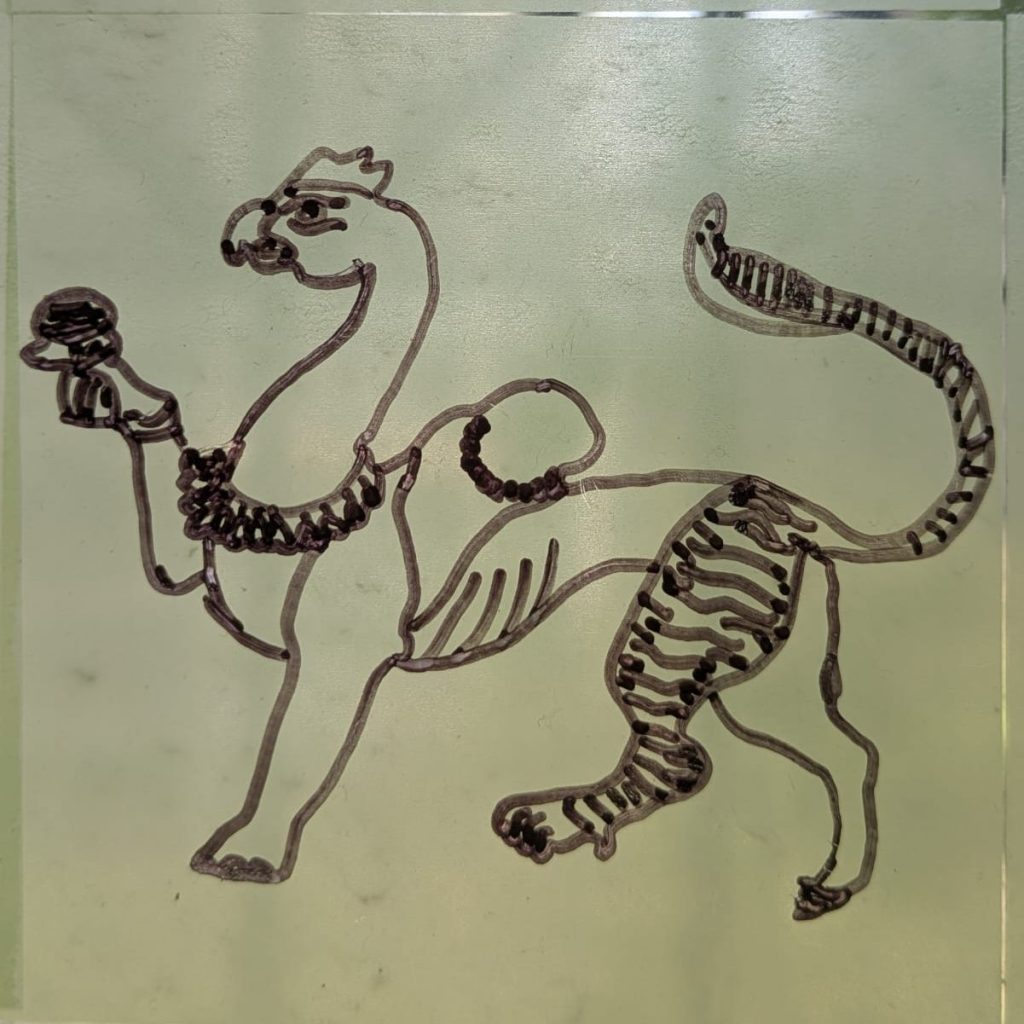
“It has the head of a rooster, the neck of a peacock, the hump of a bull, the waist of a lion, the tail of a serpent, one foreleg of an elephant, one foreleg of a tiger, one hind leg of a deer or horse, and a human hand holding a lotus or chakra. Nine bodies, one creature.”
That is Nabagunjra.
The name itself tells you everything.
Nava means nine. Gunjra, derived from the Sanskrit Gunjara, means the one who moves, who roams, who hums.
And for centuries, the people of Odisha have been painting it, weaving it, singing about it.
The Time It Found Me
The moment I first drew Nabagunjra, after discussing and reading about it during one of my writing projects, I felt an uncanny familiarity, as if reconnecting with an old friend. But nothing beyond that sketch happened…it remained just there and is still there!
Until recently, almost a year back, I was in a conversation with a group of people from The Alchemy Network, and we were all asked.
“If you had to choose one character that would shape your next body of work, what would it be?”
People around me were naming the heroes, icons, famous figures, and plots.
I said, “Nabagunjra.”
I can tell you that it was instinctive!
Everybody looked at me with surprise and kind of asked me the immediate question- Who?.
I was surprised myself because I had not thought about it. And I remember thinking, “Why did I say that?”
Because the truth is, I didn’t know much about Nabagunjra, though I had read about it briefly for my work.
Or.. maybe I did…Just not consciously.
And I realized, perhaps for the first time, that I had been carrying this creature with me for years.
What It Actually Is
According to Sarala Das’s Odia Mahabharata, before the great battle of Kurukshetra, Arjuna engaged in intense penance and meditation in the forest on Manibhadra Hill. Upon sighting this bewildering creature, Arjuna initially mistakes it for a demon and reaches for his bow, preparing to launch an attack to defend himself. Before the encounter intensified, Arjuna recognized the virat rupa of Lord Vishnu as Nabagunjra, a divine manifestation of the Lord.
“This encounter illustrates bhakti over illusion, faith over confusion, and unity in diversity. That is perhaps the most honest moment in all of epic literature.”
I find this extraordinary. That a 15th-century Odia poet chose, at the threshold of a great war story, to put a creature of radical multiplicity in front of his greatest warrior.
Why Now
We live in a world that is very committed to categories. Algorithms need them. Job descriptions require them. Social media profiles demand them. You are one thing: a founder, a coach, a writer, a speaker. You are one emotion: excited or sad, successful or struggling. You are one story: origin, conflict, resolution. Neat. Portable. Shareable. And underneath all of that neatness, most thinking human beings carry the secret knowledge that they are nothing of the sort.
Nabagunjra is a message to all those- Multiplicity is not complexity.
The Nabagunjra appears frequently in Pattachitra — the classical painting tradition of Odisha, practiced primarily in Raghurajpur, a village near Puri. The artists who paint it are not painting an explanation. They are painting a recognition. The creature is never depicted as threatening or monstrous.
It is regal. Composed.
It moves through its own world with a kind of dignity that asks nothing of the viewer except presence.
I have stood in front of Pattachitras featuring Nabagunjra many a time; I have seen artists drawing them and shaping a narrative around them, and I have felt that they contain more than I expected.
This series, these nine blogs, is my way to know more, notice more what Nabagunjra has to offer. I don’t fully understand Nabagunjra even now. But I know that Nabagunjra knows the path, and I am just the medium.
I am writing this series not as a scholar.
I am writing it as someone who grew up seeing Nabagunjra in paintings and on walls and in the folds of festival fabric, and who only recently, in the last few years, stopped walking past it and looked deeply into it.
Eight more pieces follow this one, and each of them lives inside the number nine — Navarasa, Navanidhi, Navadurga, Nava Vyuha, the nine seas that Odisha has always known, the nine ways of breaking and returning. But they all begin here, with this creature in the forest, with a warrior who could not name what he was looking at, with a poet in the 15th century who decided that this was exactly the right place to introduce this creature.
It is always the right place to begin. With the thing you cannot categorize. With the presence that holds too much for one word. With the creature that is nine bodies and one roaming, humming, impossible life.
I am glad I finally stopped walking past it.
And realized why it was never meant to be understood the way everything else I do, because there is a Nabagunjra that lives within me.
Time to explore that!
Well researched article. It gives a deep insight on the Nabagunjra. It was a wonderful read.
thank you so much for reading through.. glad you could connect to it.
Congratulations for introducing the world to this mythical character.. you are right, for us Odias it just exists in our lives without demanding any attention. We know it and we don’t. It surely represents multiplicity that is inherent to human character. Looking forward to reading the future articles.
thank you so much Surabhi.. Yes Nabgunjra means so much to us !!