
On Navarasa, Nabagunjra, Jagannath, and the emotions we carry without names.
Several things, simultaneously, layered over each other the way sediment layers over years, each stratum present, each distinct if you press down into it, and yet from the surface what you see is only the accumulated texture of all of them together.
You are not sad exactly. You are not happy. You are not anxious, though something adjacent to anxiety is there. You are not at peace, though there is a stillness in it. You sit with this unnamed thing, and you think: I should be able to name what I feel. I am an adult. I have language. And yet the language keeps arriving late, or arriving wrong, or arriving and not quite fitting the shape of what is already there.
Has that ever happened to you?
When someone asks, “How are you?” this feeling comes and goes, and then we answer with the ordinary.
Lately, as I find myself approaching forty, I’ve begun to notice something curious: I’ve noticed that human emotions refuse to stand in a queue.
Even before you call their names, they are all ready to roll!! Like unexpected guests who have mistaken your heart for a meeting place.
While researching Nabagunjra, I found myself wandering into Bharata Muni’s world, who developed the concept of rasa and gave the world The Natya-shastra.
I read this somewhere that Bharata Muni wasn’t writing about theatre.
The theatre was simply his laboratory.
He was studying us.
He watched audiences laugh at strangers, cry for fictional characters, sit breathless through battles they knew were imaginary, and walk away feeling lighter than when they had entered.
Most people would have called that entertainment.
He called it understanding.
Centuries before modern psychology began drawing diagrams of human emotion, Bharata Muni had already begun asking a question.
What exactly happens inside us when we truly experience something?
He didn’t leave us with a vague philosophy.
He left us with what almost feels like an equation.
विभावानुभावव्यभिचारिसंयोगाद्रसनिष्पत्तिः
Vibhāvānubhāvavyabhicārisaṁyogādrasaniṣpattiḥ.
Emotion, he suggested, does not simply appear. It arises from a meeting, certain circumstances, memories of the past, expression, and sometimes from countless invisible threads weaving together until something inside us becomes impossible not to feel.
He called this experience Rasa.
The closest translations are taste, essence, flavor. But none of them define it enough.
रस्यते आस्वाद्यते अनेन इति रसः
Rasyate āsvādyate anena iti rasaḥ
“That which is tasted, that which is relished—that is Rasa.”
Imagine someone hands you a perfectly ripe mango. You can describe its color and measure its weight. If you are aware of how it grows, then you may be able to explain that too. But have you thought about it: no matter which vocab you use, you can define the true taste only when the fruit meets the tongue… that’s Rasa!
It is not the emotion itself; it’s more than that; it is what the emotion becomes when it meets a human being.
Perhaps that is why stories stay with us long after facts disappear.
And that brought me back to something I had been thinking about ever since I began writing this series.
Nabagunjra.
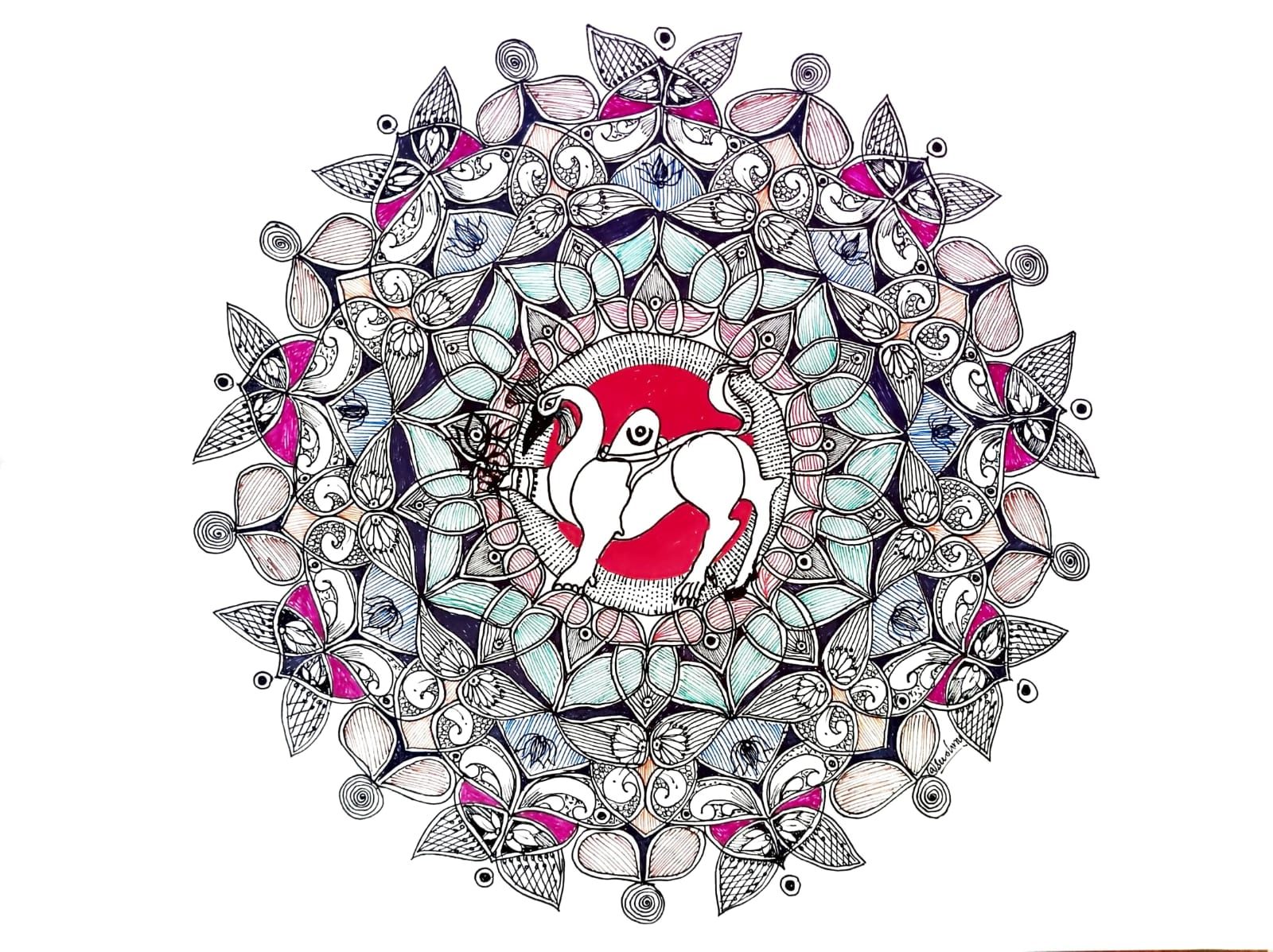
The impossible creature with nine forms.
Nine.
Nine forms.
Nine nights of celebration.
Nine openings in the human body according to Indian philosophy.
Nine months before birth.
Nine circles that somehow keep appearing in mandalas I draw without planning them.
Nine emotional landscapes mapped by Bharata Muni.
Did it ever happen to you that you notice something, and then you notice that you noticed it?
The first flutter of a baby inside you.
A pattern that suddenly appears everywhere.
A habit you didn’t know you had until someone held up a mirror.
That’s how this journey began for me.
Recently, while working on myself and understanding myself, I often find myself thinking that our heart is not a single room; it’s a house, an old one.
The house we live in is well furnished and organized, with designated areas, a chair by the window, plants in the corner, and cupboards full of essentials.
But when I think of this old house, happiness is always just a tiny step next to the window; if you check upon fear or concerns, their suitcase is always ready, sadness chooses the corner where no one can see it, and we start feeling that this is all our old house has within. In contrast, the truth is we forget the rest of the house exists.
Then life opens another door.
You notice the beauty- around you, within you, in nature, in people, in things… never measured in size but in attention.
The next room is lighter, where life echoes; you would find children here, laughter that catches you off guard; for me, that happens sometimes while washing dishes, and sometimes laughing my heart out at a conversation everyone else has already forgotten.
Further down the corridor is a room that most of us enter reluctantly.
It smells like a box of old letters, silent corridors, conversations that ended too soon.
Often I thought about entering it alone, but then I was introduced to compassion. With compassion, walking down this corridor becomes easier, less overwhelming. Trust me, this corridor looks empty but carries so much weight that sometimes no advice works; compassion never leaves your side; it stays.
Healing begins in this corridor and not when pain disappears, but when it discovers it no longer has to carry itself.- one lesson I’m working on remembering and believing in
Then there is another room, often considered bad and destructive, like a fire.
There have been moments when I have felt an unexpected anger; sometimes I even apologized for that feeling. But you know, behind anger, these tiny little ones are sitting- calmness. love. I am now hanging out with this more, especially when anger tries to test me.
When I write it, it feels that way because of how we were told about emotions and how we presumed them to be; every emotion, it seems, has a misunderstood twin.
Beyond that room is courage. Which sounds like a big biggie but actually is the softest of all. It may remind you of all those fears and worries, but only to hold you through your first step toward growth, and then the next, and then the next.
For me, it’s the idea of being a solopreneur, and I’ve been working on it for the past 5 years.
And there is a closed room. We seldom open it, waiting for the right time, or sometimes we just don’t want to. It contains everything that makes us recoil.
This may be one of the most honest rooms in the house. Because what disturbs us reveals our values as clearly as what attracts us. It’s tough to be in this room, but someone recently told me to choose whether you wish to stay here, clear the clutter from here, leave something as it is,s or see it differently. No pressure attached;d absolutely a choice to make,ke which we are allowed to.
And then there is this one room that often takes up most of my time during the day.
It is where curiosity lives.
Every meaningful project I have ever begun started here.
A question that refused to leave.
Why does this symbol keep appearing? Why nine?
Why do Jagannath’s eyes look different every time I visit?
Why does a mandala begin revealing patterns only after I stop trying to control it?
Wonder has never demanded answers from me and only brought better questions.
Which is perhaps why it never grows old.
And finally…
There is one last room.
Curiously, it contains almost nothing—only light.
It is the light that was always there, beneath the other rooms, beneath the noise of the house, waiting with the particular patience of something that knows it will not be rushed. Shanta is not what you feel after everything has resolved. It is what you discover when you stop needing it to.
I often meet it when I finish brainstorming an idea, when I start asking myself certain questions, when I see my face; it lights it up even if I am not looking at the mirror. I
And when I finally read all nine rasas aloud — Shringara, Hasya, Karuna, Rudra, Veera, Bhayanaka, Bibhatsa, Adbhuta — I heard the house.
Each room, already named. Each feeling, already mapped by someone who had sat with human beings two thousand years ago and noticed what we try to hide even from ourselves.
Centuries later, Abhinavagupta, a Kashmiri philosopher and perhaps the most careful reader of the Natyashastra, said that Shanta was not another room alongside the others. It was the floor beneath all of them—the ground the whole house was built on.
Peace.
Which made me think, again, of Nabagunjra. Nine forms. Belonging together. Not despite each other. Because of each other.
Like the rooms of an old house.
Like chapters of a single life.
Like the human heart itself.
Jagannath’s eyes, I think they are the emotional center of everything I am trying to say here. And do you know why people connect with him in the simplest ways? Because his eyes reflect whatever the viewer brings.
The devotee who comes weeping encounters compassion in them. The child who arrives laughing finds delight. The person carrying rage meets something that absorbs the rage without flinching. The one who comes in a state of hollow, unnamed ordinary feeling finds — something. Something that sees all of it at once, without requiring it to resolve into a single name.
In two weeks — as I write this, it is the first week of July — Lord Jagannath will leave the temple at Puri and travel the Grand Road to the Gundicha temple, three kilometers away. The chariot is called Nandighosh, which means the one that brings joy through its tumultuous sound. It is forty-five feet tall. It is built entirely from scratch, every single year, from four thousand pieces of wood, no nails, following specifications that have not changed in a thousand years. A million people will stand on that road. The festival will span nine days. Of course, nine days. Everything in this tradition keeps returning to nine.
Jagannath’s eyes are Navarasa. All nine, simultaneously present, simultaneously
All nine rasas, present simultaneously.
Like the rooms of an old house that exist whether or not you open the doors.
And as you continue reading, I want to say: the house is larger than you thought.
The feeling you are carrying — the one that doesn’t have a word yet, the one you answered “fine” over when someone asked — it has a room. It has always had a room.
You already know it too.
You’ve just been standing in one room for so long that you forgot the corridor exists.
Go a little further.
The light at the end is not a destination.
It was always the floor..